

WHAT A FAILED JOHANNESBURG PROJECT TELLS US ABOUT MEGA CITIES IN AFRICA
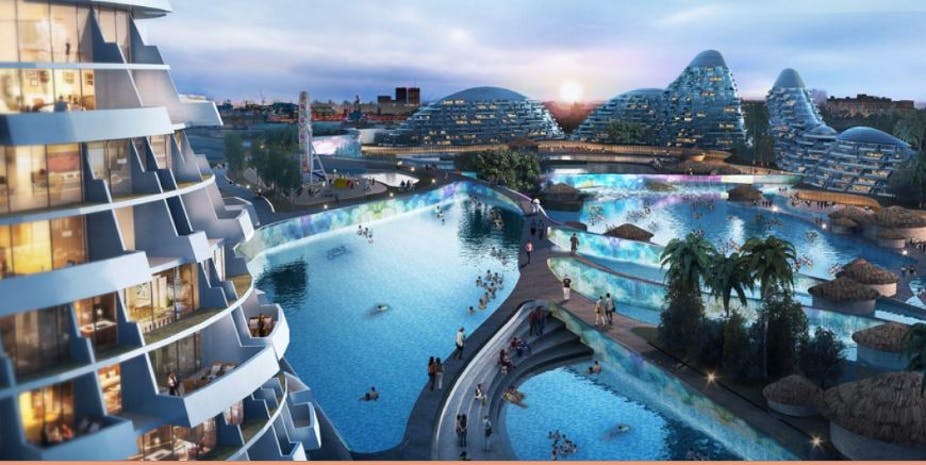
Six years ago Modderfontein New City project was announced in South Africa. Billed as a game changer, it was meant to alter the urban footprint of Johannesburg, Africa’s richest city, forever.
Zendai, a Chinese developer, bought a 1600-hectare site north-east of Johannesburg for the development, dubbed as the “New York of Africa”. Early plans showed it was to include 55,000 housing units, 1,468,000 m2 of office space and all the necessary amenities for a single large-scale urban district. The cost estimate was set at R84 billion.
The developers believed that Modderfontein could function as a global business hub and would become Johannesburg’s main commercial centre, replacing Sandton. The project would also strengthen relations with Asian corporate interests.
But, despite the release of futuristic computer-generated images which led to significant publicity for the project, it was never built. Instead, the land was eventually sold off. Another developer has since begun construction on a much scaled-down project – a gated-community style housing development.
Modderfontein has faded away from the public consciousness. The story of why it failed has never been adequately told in the media.
Our research, which took place over the course of several years, sought to understand the factors which led to the project’s demise and how Modderfontein’s failure relates to the broader African urban context.
We found that the project was hindered by conflicting visions between the developer and the City of Johannesburg. Moreover, unexpectedly low demand for both housing and office space meant the original plan for the project was incompatible with the city’s real estate market.
The project’s trajectory also shows how African “edge-city”developments, which are generally elite-driven and marketed as “eco-friendly” or “smart”, can be influenced by a strong local government with the means and willingness to shape development.
Conflicting interests
Zendai’s aspirations to produce a high-end, mixed-used development did not fit with the City of Johannesburg’s approach. Rather than a luxurious global hub, the city wanted a more inclusive development – one which reflected the principles outlined in its 2014 Spatial Development Framework.
To this end, the city demanded that Zendai include at least 5 000 affordable homes in its plans. It also wanted to ensure that the development was compatible with, and complemented, Johanneburg’s public transport system. The city was willing to contribute funding for the necessary infrastructure and inclusive housing.
Yet Zendai remained steadfast in its commitment to its vision, eventually deciding against fully integrating the city’s wishes into its planning application. This saw the city draw-out the planning process.
Meanwhile, problems were mounting for Zendai. The owner, Dai Zhikang, was eventually forced to sell his stake in the project to the China Orient Asset Management Company. The asset managers sold the land to the company behind the new housing development on the site.
Smart cities in Africa
Over the last decade, a variety of developments like Modderfontein, including Eko-Atlantic in Nigeria, New Cairo in Egypt, and Konza Technology City in Kenya, have been touted by public and private sectors as panaceas for Africa’s urban problems. The thinking is that as the developments are disconnected from the existing urban landscape, they won’t be burdened by crime or informality. However, these projects can take badly needed resources away from the marginalised areas of the city.
To make them more palatable to domestic and international audiences, the developments are usually marketed as “smart” or “eco-friendly”.
But these developments can fail at the point of implementation. This is because, as speculative projects, they generally don’t recognise the need to fit in with the wishes of the local authorities or adapt to the existing city. In the case of Modderfontein, the city government had the capability to push back against the developers and, in the end tried to shape the project to better fit Johannesburg’s urban realities.https://theconversation.com/what-a-failed-johannesburg-project-tells-us-about-mega-cities-in-africa-112420


