

TRANSPORT AFRICA RESEARCH PROJECT MEET ON USING LOCAL MATERIALS IN ROAD CONSTRUCTION
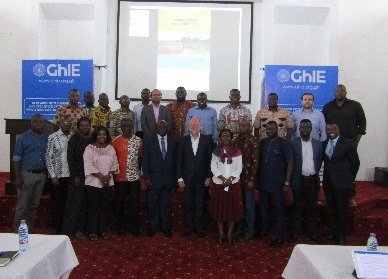
Transport Africa Research Project stakeholders have held a conference in Accra to discuss the use of local materials in road construction.
The UK-funded project is investigating the sustainability and resilience of transportation infrastructure (roads and railways) in Ghana, Tanzania and South Africa.
Professor Samuel Ampadu, the project investigator from the Kwame Nkrumah University of Science and Technology, said the project was investigating the use of local materials for road construction in low trafficked rural roads.
As a non-renewable natural resource, good-quality materials meeting all the specifications are becoming increasingly difficult to find close to road construction projects.
Field trials in other African countries have demonstrated that many local materials that occur naturally in the ground, can perform satisfactorily as construction materials.
They can be used to construct all-weather roads when they are provided with a bituminous surfacing. This means that the existing specifications for road construction materials need to be updated.
Using local materials provides significant cost savings, as well as being more environmentally sustainable.
But local materials not meeting the specifications are more sensitive to water movements into the road than those traditionally used. Therefore, the research has to identify what materials can be used in particular climatic conditions.
The project team had therefore installed instruments to measure moisture changes in roads in different climatic regions of Ghana and Tanzania and in a railway embankment in South Africa.
The sensors will be able to detect the amount of water penetrating into the road or railbed and the changes in the properties of materials as they become wetter and drier.
The Transport Africa project is funded by the UK Global Challenges Research Fund. This is a £1.5 billion (GH¢ 10 billion) fund from the UK Government to support cutting-edge research that addresses the challenges faced by developing countries.
Transport Africa has received support of £1.1 million (GH¢ 7 million). The project is led by Durham University.
The work in Ghana is being done by Kwame Nkrumah University of Science and Technology, with partners being University of Pretoria, South Africa and Nyaoro & Associates in Tanzania.
“This project should also be a catalyst for local research. We hope the Ministry of Roads and Highways will commit funds for local research. Given the large investments the nation makes in transport infrastructure development and maintenance, it is important that infrastructure performs as intended and also any small savings on every project will cumulatively become a large saving”, Prof. Ampadu said
Professor David Toll, the project leader from the Department of Engineering at Durham University, said: “We are very pleased to have the opportunity to present our research findings to key stakeholders in Ghanaian government departments and companies in Accra. It is essential that our research has practical value to Ghanaian civil engineers. We want to see the findings being used to allow more economic all-weather road construction that will benefit people living in rural areas.”


